
When a country wins the World Cup, its tattoo studios stop booking anything else for weeks. Argentina lived this in 2022 — Messi, the trophy and the blue-and-white, artist after artist, fully booked. For a football country, a World Cup tattoo is almost a reflex the night the trophy is won — and 2026 will be no different.
Your hero — and why a silhouette outlasts a face
For most fans, the World Cup tattoo is a player. After Qatar, Argentine studios reported the order of demand as the trophy first, then Messi, then the goalkeeper Emiliano Martínez — and the players are where the feeling actually lives. A hero tattoo is a tattoo of the person who handed you the best night of a decade, and football gives fans heroes the way few other things do.
The default instinct is a photoreal portrait of the face. It's also the single hardest tattoo to get right and to keep. Fine facial detail spreads as skin ages, and an artist working fast through the post-final stampede can miss a likeness by the few millimetres that turn your hero into a stranger. The tattoos that go viral for the wrong reasons are almost always rushed portrait work.
Ideas that carry the same meaning and survive far better:
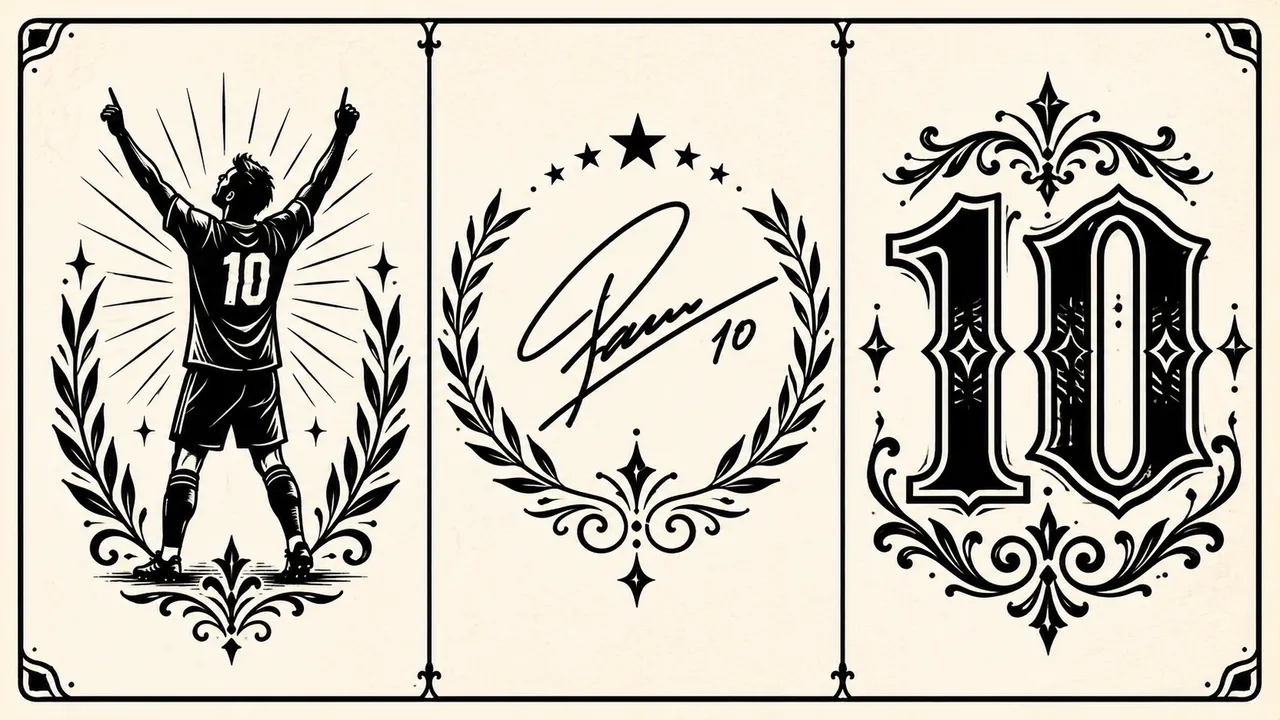
- A celebration silhouette. Maradona's arms thrown wide, a striker wheeling away after a goal. A silhouette reads across a room instantly and doesn't live or die by millimetre-perfect linework.
- The signature. A player's autograph is personal, compact, and unmistakable to anyone who would recognise it in the first place.
- The number. №10 carries Maradona, Messi and Pelé in one mark. A bold, cleanly drawn number is about as timeless as a football tattoo gets.
- "D10S". Maradona's nickname — the Spanish Dios built around his 10. Five characters that say the whole thing to a fan.
- The lineage. Plenty of Argentines who already wore Maradona added Messi beside him after 2022 — two heroes, one inheritance, one arm.
A lot of World Cup tattoos are someone's first ever, booked on adrenaline. If that's you, the first-tattoo guide is worth ten minutes before you sit down.
Your country, and how to wear it well
The second thing fans reach for is where they're from. One Argentine fan described his piece — Messi in the blue-and-white striped shirt, kissing the trophy — as "what it means to be Argentine." The stripes weren't decoration. For him they were the team, the country, the whole thing.
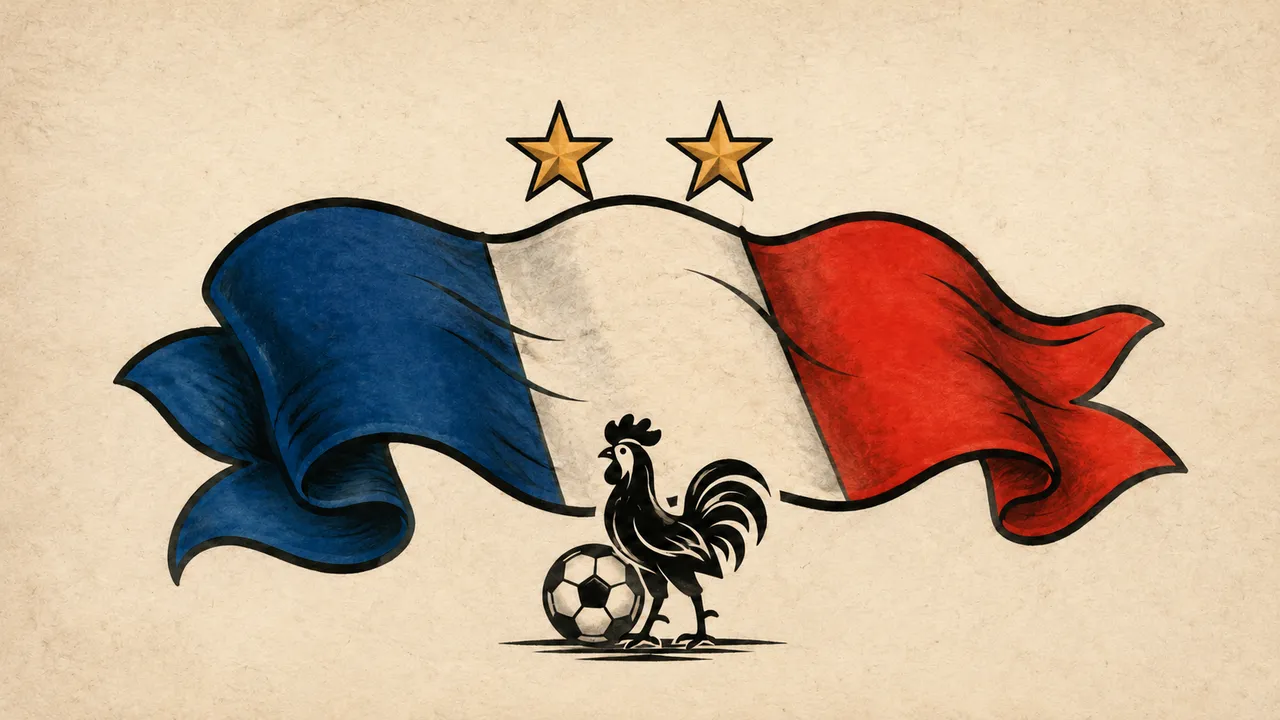
Football is one of the few places national identity gets worn with no irony at all. It holds up on skin as long as it's a real design and not a flag traced as a flat rectangle — a waving banner, the colours worked into a composition, the kit's stripes all carry it well:
- The kit. Argentina's sky-blue-and-white, Brazil's yellow, the Netherlands' orange. A band of the team's stripes or colours reads as your country to anyone who follows the game.
- The flag, as a banner. Drawn as a waving banner with movement and shading — the way traditional flash has always handled flags — it carries the country with real presence.
- Stars for titles. One star per World Cup won — Brazil's five, Italy's four, Argentina's three, France's two. Clean, easy to space along a forearm, and it tells your country's whole tournament history without a word.
- A national emblem. The sun on Argentina's flag, England's three lions, France's cockerel. The symbol carries the allegiance with or without the full flag behind it.
- The country itself. A simple line drawing of the national outline — small, quiet, and instantly legible to anyone from there.
And the strongest national pieces often fold a hero in — the fan above tattooed Messi in the blue-and-white, the country and the hero in a single piece. They're usually the same tattoo.
The moment only you were in
The strongest World Cup tattoos aren't really about the tournament — they're about your tournament. The trophy was the single most-requested design in Argentina after Qatar, and yet almost nobody got it floating on its own. They got it lifted, kissed, dated — wrapped inside a moment. A bare trophy on a forearm is the one version that tends to fall flat.
What fans actually mark:
- The date. The day of the final, in plain or Roman numerals. The most understated World Cup tattoo there is, and the one least likely to ever feel dated.
- The score, drawn rather than written. A bare "3–3 (4–2)" needs explaining forever. The same result worked into a small scene — a ball crossing a line — keeps the memory and loses the footnote.
- A famous goal, diagrammed. Maradona's 1986 run past half of England gets tattooed as a tactical line: a looping path, a few dots, a goal. It looks like nothing to a stranger and like everything to a fan.
- The vow. One fan booked hers because she had promised herself, after Argentina lost their opening game to Saudi Arabia, that she would if they turned it around and won. The tattoo is the promise kept, not the trophy.
- Where you were. The coordinates of the bar, the living room, the seat in the stadium — the exact room you were standing in when it happened.
The cleanest proof of the principle came from a player. Emiliano Martínez tattooed a small star on his leg, on the exact spot the ball struck for the save that kept Argentina alive — the moment mapped onto his own body, no trophy in sight. If a piece like this is going somewhere visible, it's worth thinking through how the spot wears over the decades — the placement guide walks the body zone by zone.
How people end up with a "fat Messi"
After Qatar, one fan's Messi tattoo went viral for the wrong reason — rushed and done cheap, it gave the best player alive a double chin. It wasn't a bad idea. It was a bad booking.
The real regrets almost never come from getting something meaningful. They come from three things.
Rushing it. Studios are slammed in the days after a final, and a portrait done in a hurry is a portrait done badly. A hero's face is the hardest work a tattooist does — budget for someone good, and let them take the time the face needs.
Getting ahead of the result. People tattoo "champions" while their team is still in the tournament. England fans have a whole genre of pieces that aged badly the moment a promising run ended. Wait for the actual final whistle; the tournament will still be there to commemorate afterwards.
Putting it where you can't walk it back. The fan who had "Messi" inked across his forehead has spoken about how much it changed ordinary daily life. Love the player; keep the tribute somewhere a future job interview survives.
None of this should talk you out of a World Cup tattoo. It's just the line between the version you keep for life and the version that ends up as someone else's screenshot.
Design it before June, not in the queue after the final
The 2026 World Cup runs June 11 to July 19 — the first 48-team tournament, hosted across the United States, Canada and Mexico. A month of football, and a month of studios filling up fast. The fans who come out happiest tend to be the ones who knew what they wanted before the rush started.
This is where seeing the design first genuinely helps. InkedByAI's generator turns a text prompt into a tattoo-ready design across 22 styles, and it handles the things World Cup fans actually want. Type a player in a striped jersey lifting a trophy, number 10, bold traditional and a clean, finished design comes back in seconds — we ran exactly that prompt, and it landed the figure, the jersey, the number and the trophy in a single pass. Six free credits is enough to try your hero as a silhouette, your country's stars, three or four directions for the moment, all before an artist quotes you anything. The AI design walkthrough goes deeper on writing prompts that give an artist something to work from.
One honest limit. The generator is excellent for composition, style and colour — the shape of the design — but a specific, recognisable likeness of a real player is where AI still wobbles. For a portrait that has to unmistakably be Messi, take a strong reference to a human artist and let them land the face. And no preview, AI or otherwise, can tell you whether you'll still want this at forty. That test only time runs.
A World Cup tattoo is a good idea — most fans who get one never regret it. The ones who don't are the ones who got their hero, their colours, or their night, made well, by an artist they didn't rush. Work out which of those three yours really is, sketch a few versions before the tournament kicks off, and book the one that still feels right a week after the final.
