Most "Japanese tattoo" guides hand you a list of 10 symbols with one-sentence meanings. The actual reason people commission irezumi — and the reason artists still spend years apprenticing in this style — has more to do with what these symbols mean in relation to each other than with their isolated definitions.
TL;DR: Japanese irezumi tattoos carry 800-year-old layered meanings. Dragons signal wisdom and benevolent power. Koi signal perseverance and transformation. Sakura signal impermanence, not just decoration. Traditional designs cover full sleeves or backs, not isolated patches.
The 800-year arc that made irezumi what it is
Japanese tattooing predates almost every other tattoo tradition that has reached today. Evidence of marked bodies in Japan goes back to roughly 10,000 BC with the Ainu people, who tattooed hands, forearms, and mouths in indigo for adulthood, protection, and aesthetic.
The art form we now call irezumi crystalized during the Edo period (1603–1868). Two pressures shaped it. The shogunate used tattooing as criminal punishment — visible marks identified offenders. At the same time, ukiyo-e woodblock artists were producing some of the most refined narrative imagery in Japanese visual culture, and that compositional vocabulary started moving from paper to skin. Edo-era tattoo masters borrowed directly from Suikoden hero illustrations and other woodblock sources. The technique stayed manual — tebori, hand-poking with a hafted needle — well into the 20th century.
The Meiji government banned tattoos in 1872, hoping to clean up Japan's international image during its Westernization push. The ban drove the practice underground. For most of the next century, the group keeping irezumi alive was the Yakuza, Japan's organized crime federation. Their full-body suits — sleeves, back, chest panel, thigh wraps — became the defining image of Japanese tattoos in the popular imagination.
The ban formally lifted in 1948, but stigma persisted. Meanwhile the technique and aesthetic spread globally — by the 1990s, master Horiyoshi III's documented work brought irezumi into international visibility, and by the 2010s, traditional Japanese was one of the most-requested style families in Western tattoo studios.
Today the style sits in two places at once. Internationally it's a prestige aesthetic — bold, narrative, technically demanding, expensive. Domestically in Japan it's still flagged as outsider art. A modern collector should know both, because both are part of what the design carries.
Japanese tattoo symbols aren't decorative. Here's what they mean.
Most introduction guides list ten symbols with one-line meanings — "dragon = strength, koi = perseverance, sakura = beauty." The list isn't wrong, but it's missing the layer that makes irezumi different from generic motif tattooing. Each symbol is a story with internal logic, and the way it's drawn tells you which part of the story is being invoked.
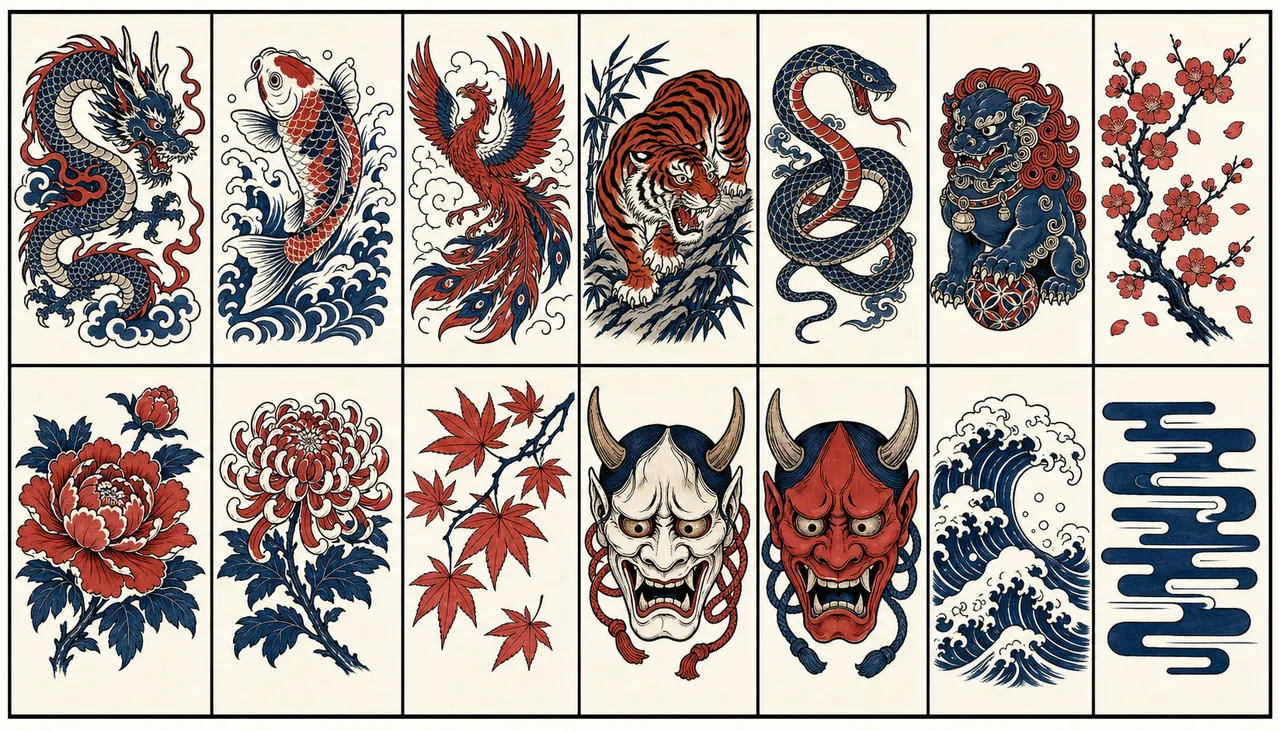
Dragon (ryū). The Japanese dragon is a composite creature — eyes of a rabbit, ears of a cow, neck and belly of a snake, horns of a stag, scales like a koi, talons of an eagle. It's a benevolent water spirit associated with rain, wisdom, and worldly blessings, not the chaos-bringing fire-breathers of European tradition. A dragon facing upward suggests aspiration; coiled around a sacred jewel (hōju), it suggests guardianship of knowledge.
Koi. The koi fish is inseparable from the Dragon Gate legend: a koi that successfully swims up the falls of the Yellow River at a specific point transforms into a dragon. The fish stands for perseverance through hardship, but the direction of the fish in your tattoo matters — swimming upstream means you're still in the struggle; swimming downstream means you've already passed through. Many koi tattoos are commissioned at career transitions for exactly this reason — though there's no formal canon enforcing the directional convention; it's one of those traditions that lives in artist-client conversation, not in a textbook.
Sakura (cherry blossoms). The most commonly misunderstood symbol. Sakura is not a "pretty pink flower" — it is the Japanese cultural reference point for mono no aware, the awareness that beauty is fleeting and that everything dies. Samurai wore sakura imagery specifically because both bloom briefly and fall in full splendor. A sakura tattoo is a meditation on impermanence. Tattoo-shop staff who let people get sakura for "just looking nice" are missing the point.
Phoenix (hō-ō). Imperial bird associated with rebirth, triumph over adversity, and the feminine to the dragon's masculine. Often paired with dragons in larger compositions as complementary forces.
Tiger (tora). Protector against evil spirits, courage, primal force. The tiger isn't native to Japan — it came in as a continental import, which is partly why it sits as an "outside" energy in irezumi composition.
Snake (hebi). Protection, regeneration, recovery from bad luck — a snake sheds its skin, so the rebirth association is literal rather than poetic. A white snake reads specifically as a messenger of Benzaiten, the goddess of fortune, and is the most auspicious version; a plain serpent doesn't carry that. Snakes are nearly always drawn coiled around something — a sword, a skull, a peony — and what it wraps changes what it means.
Hannya. A demon mask from Noh theater representing a woman whose jealousy or grief has transformed her into a vengeful spirit. Hannya isn't a generic "scary mask" — it specifically references female rage and the cost of betrayal. Worn by people who haven't traced the story, it can read as costume.
Oni (demon). The horned ogre of Japanese folklore, and the symbol people most often mix up with hannya. Hannya is one specific story — a woman consumed by jealousy; oni is the whole category of demon. Read an oni as a stock villain and you miss half of it: a fearsome guardian that scares off worse spirits is just as common a reading, the same logic as the snarling guardian statues outside temple gates.
Karajishi (foo lion). Guardian creatures, often shown around peonies (botan). Loyalty and protection.
Peony (botan). The king of flowers — wealth, elegance, and a bold, devil-may-care confidence. Where sakura is about things ending, peony is about flourishing without counting the days. It travels with the karajishi lion so reliably that the pairing has its own name, karajishi botan — see a peony in a Japanese piece and a lion usually belongs nearby.
A working principle: don't commission a symbol you can't explain in two sentences to someone who asks. Not because they will ask — because you should know.
The rules of the form — scale, placement, and why background isn't filler
Ask a traditional artist what makes a tattoo actually Japanese and the answer is short and surprisingly strict — three things. It has to be large: Western tattoo culture treats designs as individual pieces, a rose here, a dagger there, a memorial banner somewhere else, while irezumi treats the body as a single canvas built for sleeves, backs, and full panels. It has to draw on the Japanese visual vocabulary — the creatures, flora, and folklore above, composed the way ukiyo-e composed them. And traditionally it's worked by hand, tebori, rather than with a machine. The first rule — scale — is the one Westerners underestimate most, so it's worth starting there.
The three classical zones:
Full sleeve (sode) — arm-length composition, usually featuring one major subject (dragon, koi, phoenix) embedded in background elements (waves, wind bars, clouds, peonies). The background isn't decorative filler; it provides the narrative weather the subject moves through.
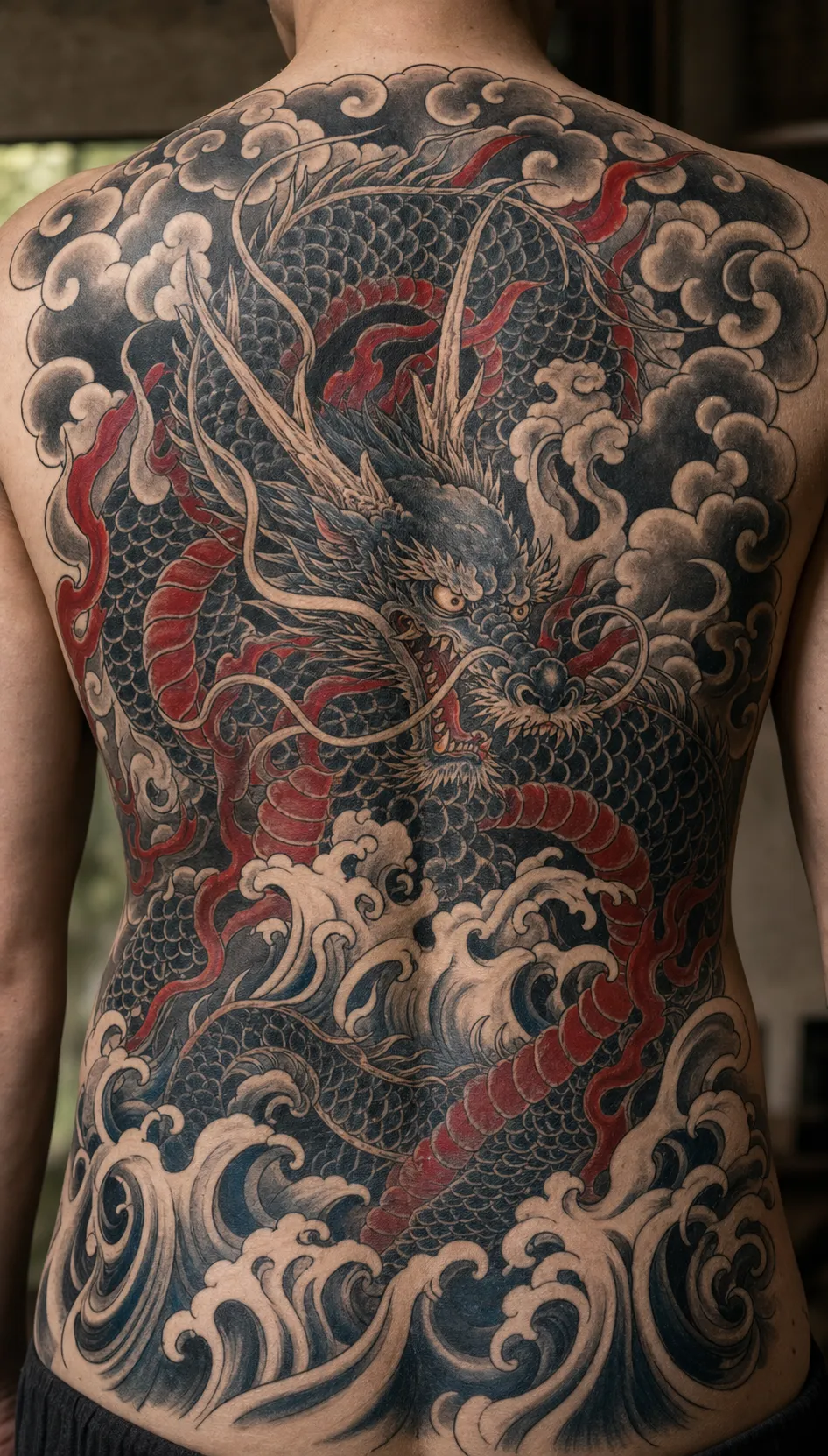
Back piece (senaka) — the largest single canvas, typically built around one dominant scene. Suikoden hero portraits became iconic back pieces in the 19th century. Modern back pieces often pair a major creature (dragon, tiger, koi) with a smaller secondary character or natural element.
Chest panel (munewari) — a torso composition that wraps around to connect with sleeves and back, forming a continuous suit. This is the full-body irezumi — sleeves + back + chest panel + thigh wraps — that traditional masters spent years executing on a single client.
These zones are load-bearing. The subject and background develop together, the lines of motion in the background carry the eye across the subject, and the negative space is composed, not accidental. A traditional Japanese tattoo without considered background often reads as incomplete to anyone with reference to the style.
This is why where you place a Japanese piece matters more than for most styles — picking "a koi on my forearm" without thinking through the surrounding sleeve composition usually means committing to an unfinished design or boxing yourself out of a future sleeve.
Knowing what you're wearing before you wear it
Cultural appropriation is a worn-out frame and often applied carelessly, so set the term aside for a moment. The practical question for an irezumi commission isn't political — it's about whether the design carries meaning you can stand behind for the rest of your life.
The risks are practical. A sakura tattoo worn by someone who thinks it's "a pretty Japanese flower" will eventually meet a Japanese acquaintance, a knowledgeable tattoo artist, or a curious friend who asks "do you know what that means?" Not knowing the answer is uncomfortable. Knowing it imperfectly is worse — describing sakura as just "beauty" misses the entire mono no aware tradition the symbol exists to invoke.
The risks compound for Hannya, which has specific gender and emotional weight, or for any symbol with Yakuza-adjacent meaning. Many Japanese-style sleeves in the West use imagery that carries different connotations in Japan than in international tattoo culture. None of this is forbidden — irezumi has been globalized for decades and contemporary artists work across cultures every day. But the difference between a tattoo that lands and one that reads as costume is whether the wearer knows what they're wearing.
There's also a consequence that has nothing to do with symbolism at all. In Japan a visible tattoo still reads as outsider marking, and that plays out at the door of ordinary places — many onsen and sento turn tattooed bathers away outright, and plenty of gyms, pools, and beaches do the same. Travelers manage it with cover patches for small pieces, by booking ryokan with private baths, or by hunting down the slowly growing list of tattoo-friendly facilities. A full Japanese sleeve is the hardest case to hide. People still get irezumi and still travel in Japan — just go in knowing a closed door here and there comes with it.
A working test: write down, in two sentences each, what every major symbol in your planned design means. If you can't, do the reading first. The cost of reading is hours; the cost of a tattoo you can't explain is years.
Where AI helps you explore — and where you still need a human
Most styles benefit from AI preview because the bottleneck is "what do I want." Irezumi is unusual because the bottleneck also includes "what should I want, given the symbolic tradition this style works inside."
What AI does well for Japanese tattoos:
- Style exploration — testing whether you respond to bold traditional (InkedByAI's generator covers traditional Japanese as one of its 22 style presets) versus contemporary neo-Japanese variants
- Subject combination — running prompts that pair a dragon with peonies vs koi with cherry blossoms, seeing whether the visual energy works before committing to a full sleeve
- Color palette — Japanese tattoos can be high-color or sumi-style monochrome; AI lets you see both quickly
- Composition tests — placing dragons in waves, koi in cloud bands, before deciding which arrangement feels right
What AI doesn't do — and what you still need an irezumi-trained artist for:
- The symbolic logic of pairings. Why dragon plus tiger together has specific meaning. Why phoenix should be balanced with dragon. AI generates beautiful images of any pairing; it doesn't know whether the pairing makes semantic sense in the tradition.
- The compositional flow of a full sleeve or back piece. Background elements (waves, wind, clouds) carry the eye between subjects. An artist designs this from understanding the tradition; AI tends to produce flat front-facing compositions.
- Placement on body. AI renders on a flat canvas; an irezumi artist designs around your specific musculature, scarring, prior work, and which direction each sleeve grows.
The right workflow: use AI to figure out what subjects and style direction speak to you. Read enough about the symbols to know what you're picking. Then find an artist who specializes in Japanese, bring your reference set as direction not blueprint, and let them compose the actual design.
The AI design walkthrough goes deeper on prompting approaches for any style. For Japanese specifically, run 4–5 variations with the traditional Japanese style preset to see which subject + composition direction resonates. If you want a contrast point with the opposite end of the scale spectrum, the minimalist guide covers restraint — useful framing for understanding why irezumi insists on density and full-body scope.
Japanese tattooing rewards the people who arrive prepared. The symbols are still meaningful 800 years in. The compositional traditions still hold. The artists who work in this style at high levels typically spend years apprenticing precisely because the tradition can be inherited — and that's most of what makes a Japanese piece read as Japanese instead of pastiche. Use AI to explore, do the reading to choose well, then find the artist who can finish what you started.
